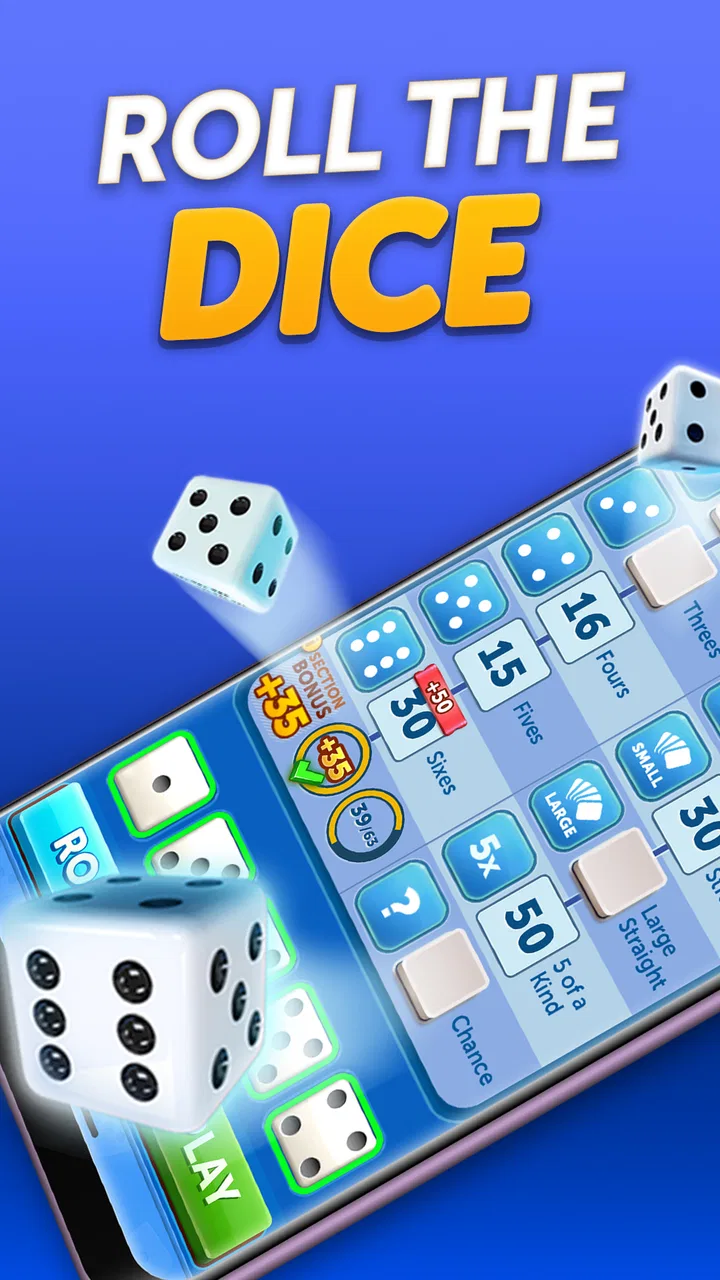
Dice With Buddies™ Social Game
- 4.1
- Rating
- 10.00M
- Installs
- Free
- Price

 Analysis by App-foxy
I have always liked board games that are easy to start but still give me a reason to return, and Dice With Buddies™ Social Game fits that space neatly. It is a free board game from Scopely built around dice play and multiplayer sessions, with a relaxed feel that works particularly well when I want something more social than a solo puzzle but less demanding than a full strategy game. I can open it for a quick turn, play several rounds when I have more time, or use it as a casual way to stay connected with friends.
My overall impression is positive, though it depends heavily on what you expect from a free mobile game. The basic entry point is welcoming, the rules are familiar enough to learn quickly, and the social focus gives ordinary dice rolls more personality. At the same time, the presence of in-app purchases means I would not describe it as a completely friction-free experience for every player. It is best approached as a casual game with optional spending, not as a traditional tabletop product transferred unchanged to a phone.
How the game feels in everyday play
The core appeal is the simple rhythm of rolling dice, making choices, and waiting for the right moment to take advantage of a good result. That simplicity is important because it makes the game approachable for people who do not normally spend much time with mobile board games. I do not need a long tutorial session or a large block of uninterrupted time to understand what I am doing. The familiar dice format also makes it easy to invite someone who may be hesitant about more complicated digital games.
You May Also Like

 Blood Strike: 2.5 Anniversary
Blood Strike’s Loadouts Turn Every Drop Into a Tactical Gamble
A close look at Blood Strike’s custom loadouts: how fast access to signature weapons reshapes its battle royale rhythm, rewards preparation, and narrows the gap between fights.

 Pandora - Music & Podcasts
Pandora’s Music Is Easy to Start, but Harder to Recover
Pandora’s strength is its low-effort path from a seed to a station. Its weak spot is how much confidence it asks you to place in connection, setup, and quiet recovery.

 8 Ball Pool
 Is Built on Rivalries, Rematches, and Routine
A close look at the rivalries, rematches, shared routines, and unanswered safety questions that turn a quick pool match into a persistent mobile community.

 Samsung Music
’s Quiet Strength Is Playing What You Already Own
Its reach comes less from spectacle than from dependable access to a personal library. That simplicity is both the app’s strongest retention engine and its ceiling.

 AccuWeather: Weather Radar
AccuWeather Review: A Quick, Clear Forecast for Everyday Decisions
For everyday plans, the best forecast is the one you can understand quickly. AccuWeather makes rain timing, radar, and local conditions easy to act on, with a few trade-offs.

 Hill Climb Racing
Why Hill Climb Racing Still Turns Crashes Into One More Run
A tiny car, a bumpy hill and one more upgrade: Hill Climb Racing keeps resurfacing because its simple chaos makes every near-miss feel personal.
More From Our News Desk



What gives the experience its identity is the social layer. Rather than treating dice as a purely solitary randomizer, the game frames them as a reason to play against or alongside other people. That changes the mood of each turn. A roll is not only about improving my own position; it can also become part of a friendly rivalry, a rematch, or a low-pressure conversation starter. For me, that makes the game more engaging than many single-player dice apps that feel interchangeable after a few sessions.
A realistic use case is an evening when a friend and I are both busy but still want to do something together. We might not have time to arrange a full board-game night, yet a few turns on a phone can keep the interaction going without demanding constant attention. The asynchronous nature of this kind of play is especially useful for people with different schedules. I can take a turn when I have a spare moment instead of requiring both players to be available at exactly the same time.
That convenience also creates one of the game’s less obvious strengths: it can fit into small gaps without feeling like a disposable two-minute distraction. A short session can be enough to make progress, while a longer session can turn into a more competitive back-and-forth. I would still avoid playing it when I need complete concentration, because the casual structure makes it tempting to check in repeatedly.
Learning the flow without overthinking it
The game is aimed at a broad audience, and that shows in the way the dice format lowers the initial barrier. Someone familiar with board-game basics can usually understand the general idea quickly. Someone newer to this type of play can learn through repetition rather than having to memorize a dense rulebook. That is a meaningful advantage over heavier digital board games, where the first few matches can feel like study time.
However, simple rules do not automatically mean shallow decisions. The interesting moments come from deciding how cautiously or aggressively to use a roll. Randomness is always part of the experience, so a poor result can disrupt a good plan and a fortunate result can suddenly change the direction of a match. I enjoy that uncertainty when I am playing casually, but players who want complete control may find it frustrating.
My practical advice is to treat each turn as a small decision rather than expecting every roll to produce a perfect outcome. Trying to force a specific result can make the game feel unfair, while accepting that luck is part of the design makes the matches easier to enjoy. The best mindset is competitive enough to make choices matter, but relaxed enough that an unlucky turn does not ruin the whole session.
What the free entry point really means
The game is free to download and play, which makes it easy to test without committing money at the outset. That matters in this category because the basic question is not whether I can access the game, but whether I enjoy its pace and social structure before considering any optional extras. I appreciate being able to judge the actual play loop first instead of paying upfront for a board game I may only open once.
There are in-app purchases ranging from $0.99 to $189.99 per item. That is the most important cost detail for anyone deciding how to approach it. Free access gives the game a low financial barrier, but the wide purchase range means I would set a spending limit before handing the phone to a child or allowing casual purchases on a shared device. The existence of expensive individual items does not mean spending is required for every player, but it does mean the purchase system deserves attention.
I would separate three ideas here. First, the game can be tried without paying. Second, optional purchases may change how comfortable or convenient the experience feels for some players. Third, paid spending does not automatically turn a casual dice game into a better value than a one-time purchase board game. If I want a predictable cost and a complete experience with no purchase decisions, a paid tabletop adaptation may suit me better. If I value free access and social play above certainty, this game has a stronger case.
Because the game is rated Everyone 10+, I would consider it suitable for a broad family audience, while still explaining the purchase side to younger players. The age rating makes it approachable, but it should not be confused with a guarantee that every family will be comfortable with optional spending. I would check the device’s purchase controls before letting a child play independently.
Where the value comes from
The strongest value is not the dice themselves; physical dice are inexpensive and easy to find. The value comes from putting a familiar activity into a convenient social format. I can play with people who are not in the same room, return to an ongoing match, and enjoy a lightweight competitive connection without setting up a table or coordinating a long session.
That makes it a good companion for friendships maintained across distance. A turn can function as a small recurring interaction, especially when both players enjoy friendly competition but do not want a demanding online game. It can also work for relatives who are comfortable with phones but do not want to learn a complex multiplayer system.
Compared with a solitaire dice app, the social context gives my decisions more emotional weight. Compared with a traditional physical board game, it is faster to start and easier to continue when people are apart. Compared with a deep strategy game, it asks for less time and less concentration. Those comparisons explain its appeal, but they also reveal its limits: it will not replace a rich tabletop night for players who want long-term planning, negotiation, or a large physical board.
The game’s long presence in the mobile market is also reflected in its current version, 9.0.15, and its broad reach. It has passed ten million installs, with an average rating of 4.1 from around 195 thousand ratings and roughly 48 thousand written reviews. Those figures suggest a substantial audience and a generally favorable reception, although I would still treat them as a starting point rather than proof that the game matches my personal taste.
Small habits that improve the experience
One useful habit is to avoid turning every match into a test of maximum efficiency. When I focus only on winning, the random rolls become more irritating and the social element fades into the background. I get more value when I use the game for different purposes: a competitive rematch with one friend, a quick check-in with another, or a relaxed way to fill a short break.
Another practical approach is to decide in advance whether I am playing for social contact or for competition. If the goal is social, I am more willing to accept a strange roll and keep the exchange light. If the goal is competition, I pay closer attention to the consequences of each choice and accept that the session may feel more tense. Making that distinction prevents me from expecting a casual match to deliver the same satisfaction as a serious strategy game.
I also recommend reviewing purchase settings before regular play. This is not because spending is unavoidable, but because the purchase range is broad enough that accidental taps could be uncomfortable. A player who wants the free experience should make that choice deliberately, rather than drifting into purchases simply because the game is already familiar.
The tradeoffs I noticed
The biggest tradeoff is between accessibility and depth. The easy dice format helps almost anyone get started, but it may not provide enough complexity for players who want a substantial campaign, elaborate tactics, or a strong sense of mastery. I can enjoy the game for repeated casual matches, yet I would not choose it as my only board game if I wanted a constantly evolving strategic challenge.
Randomness is another tradeoff. It keeps matches unpredictable and prevents every turn from feeling scripted, but it can also make a carefully planned move fail for reasons outside my control. That is acceptable in a dice game, though players who prefer skill to dominate every outcome should look toward a more deterministic strategy title.
The social design can be a strength or a weakness depending on my habits. If I have friends who enjoy this style of play, the game feels much more worthwhile. If I am playing alone and do not care about multiplayer interaction, much of its appeal is reduced. I would not download it expecting a rich solo board-game substitute; I would download it because I want dice play connected to other people.
The free model creates a final compromise. It lowers the risk of trying the game, but it also requires more awareness around optional purchases than a paid app with a single upfront price. For me, that is manageable when I keep the game within a clear budget. For families seeking a completely purchase-free environment, or for adults who dislike freemium design on principle, it may be the wrong choice even if the gameplay itself is enjoyable.
Who will get the most from it
I think it is a strong fit for casual players who enjoy familiar board-game ideas, short sessions, and friendly multiplayer interaction. It is particularly suitable for people who want something they can play with friends at different times rather than needing a live match every time. The free entry point also makes it sensible for anyone who wants to experiment before paying for a more specialized board-game app.
It can work well for families with older children, provided an adult handles purchase settings and everyone understands that luck is central to the experience. The Everyone 10+ rating supports its broad accessibility, while the social format gives family members a simple activity they can revisit without preparing a physical game.
I would be more cautious recommending it to players who want a premium, one-time-purchase experience. If I am specifically looking for no optional spending, a traditional paid digital board game is likely a better match. I would also point strategy enthusiasts toward a game with deeper planning if they become bored by the dice-driven uncertainty.
Likewise, someone who dislikes asynchronous or socially oriented play may not find enough here. The game’s identity depends on interaction, so downloading it only for a solo experience would miss much of what makes it different from ordinary dice rollers.
My buy-or-skip verdict
I would recommend trying it, but I would not recommend spending automatically. Since the game is free, the sensible first step is to see whether the turn-based dice rhythm and multiplayer structure fit my habits. If I enjoy returning for friendly matches and the free experience gives me enough to do, I can keep playing without treating purchases as necessary.
For me, the value is strongest when the game serves as a low-pressure way to stay in touch. It is less convincing as a replacement for a full tabletop collection or as a serious strategy challenge. The optional purchase range, from $0.99 to $189.99 per item, reinforces the need for a deliberate budget rather than impulse buying.
Scopely has made a board game that is easy to approach and naturally suited to short social sessions. Its 7.0 minimum operating-system requirement also makes it accessible on a wide range of older compatible devices, while the current version keeps the app positioned as an actively maintained mobile game. I would still check that the device runs it comfortably before inviting a group of friends to rely on it for regular play.
My final judgment is that Dice With Buddies™ Social Game is worth installing for people who want free, casual dice matches with a social reason to keep coming back. I would skip it if I wanted deep strategy, a guaranteed purchase-free experience, or a complete premium board game with a fixed cost. For everyone in between, it offers a convenient and approachable way to turn a few spare minutes into a shared game.
FAQs for Dice With Buddies™ Social Game
01What is Dice With Buddies™ Social Game?
Dice With Buddies™ is a social dice game that allows players to enjoy a fun and interactive experience with friends and family. It’s similar to the classic game of Yahtzee, where players roll dice to achieve certain combinations and score points. The game features multiplayer options, tournaments, and daily challenges.
02How do I play Dice With Buddies™?
In Dice With Buddies™, each player takes turns rolling five dice up to three times per turn to achieve specific combinations. Players can score points based on the combination achieved, such as a full house or a straight. The goal is to maximize your total score over a series of rounds. The app provides clear instructions and tips for beginners.
03Is Dice With Buddies™ free to play?
Yes, Dice With Buddies™ is free to download and play. However, the game offers in-app purchases that can enhance the gameplay experience. These purchases might include additional dice rolls, special dice designs, or entry into exclusive tournaments. While optional, these features can provide a more enriched gaming experience.
04Does Dice With Buddies™ require an internet connection?
Yes, an internet connection is required to play Dice With Buddies™. The game is designed to be a social experience, allowing players to compete against friends or other players online. An active internet connection enables you to participate in tournaments, send and receive challenges, and access all game features.
05Can I play Dice With Buddies™ with friends?
Absolutely! Dice With Buddies™ is designed to be a social game, offering multiple ways to connect with friends. You can invite friends to play via social media or email, join multiplayer games, and compete in tournaments. The game also includes a chat feature, allowing you to communicate with other players during gameplay.
Pros
- Engaging multiplayer gameplay.
- User-friendly interface.
- Regular updates and events.
- Cross-platform play supported.
- Variety of dice styles.
Cons
- In-app purchases can be pricey.
- Occasional connectivity issues.
- Ads may interrupt gameplay.
- Limited single-player options.
- Requires consistent internet access.

Dice With Buddies™ Social Game
Gallery